Article: Artificial plants that look real: how to recognise quality
Artificial plants that look real: how to recognise quality
We all know them: the dusty, shiny plastic plant in the corner of a waiting room. No wonder artificial plants had a bad reputation for so long. But times have changed. Modern artificial plants are so realistic that even lovers of real plants look twice. The difference is in the details. In this article you'll read what to look for when you want an artificial plant that looks real, so you know what you're buying and enjoy your greenery for years.
1. The leaf: matt, not shiny
The first thing you notice about a cheap artificial plant is the shine. Real leaves are rarely completely smooth and glossy; they have a subtle, matt or silky look. High-quality artificial plants use materials that refract light naturally. Look at the thickness too: a leaf that is too thin and limp, or stiff as cardboard, gives itself away. A good leaf feels supple and tapers slightly from the midrib to the edge.
2. Veins and texture
Real leaves have veins, small irregularities and sometimes a slight curve. On quality artificial plants those veins are visible and tangible. On an artificial alocasia, for example, you see the characteristic light veins against the dark green leaf, just like the real plant. Those details make the difference at a distance of one metre, which is where your guests usually look from.
3. Colour gradients instead of one shade
No real leaf is the same green everywhere. There are gradients: lighter at the vein, darker at the edge, sometimes a yellow or brown tinge at the tip. Cheap artificial plants are often sprayed in one flat colour, which instantly looks unnatural. Look for subtle colour nuances. The more variation, the more real the plant looks.
4. A trunk that looks like wood
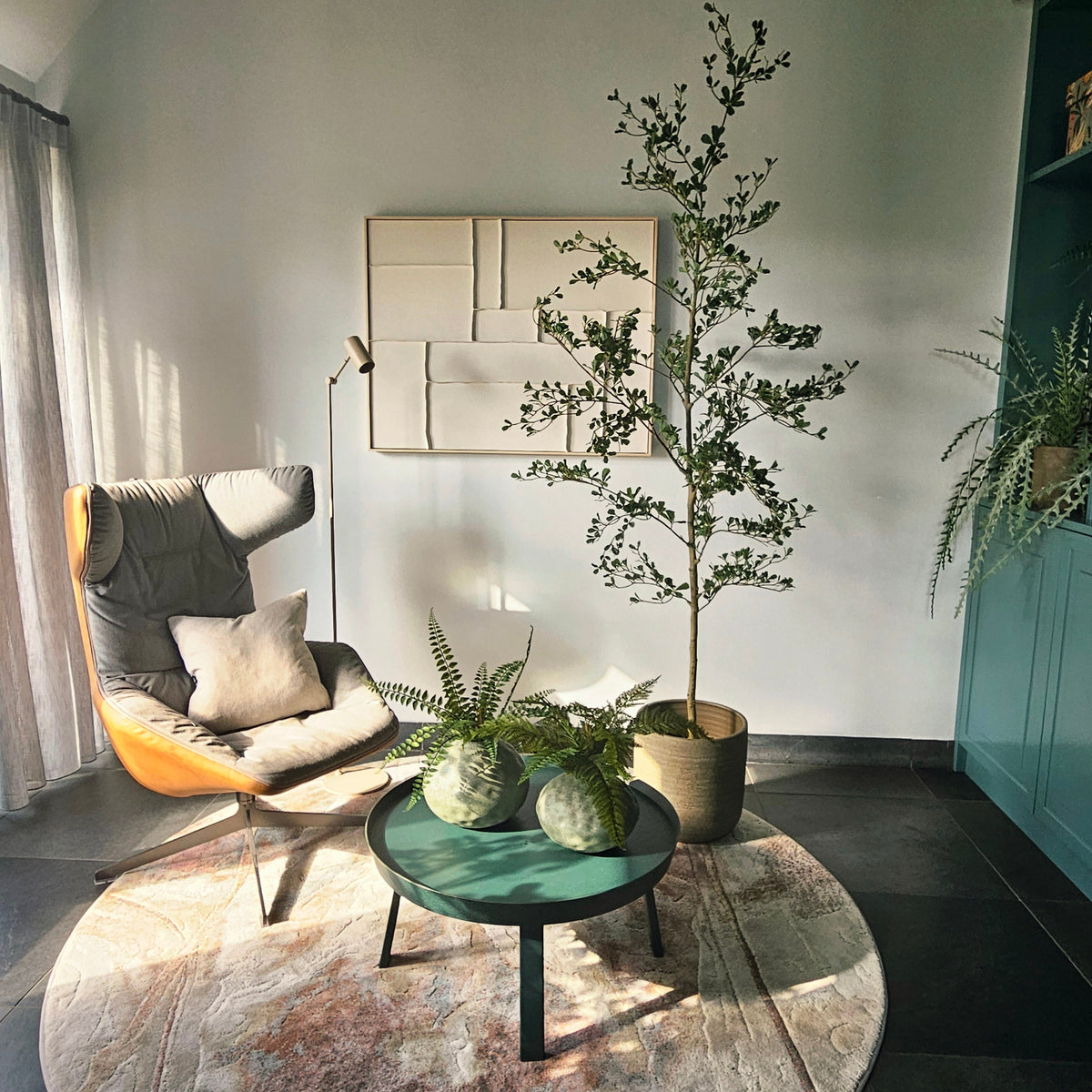
For larger artificial plants and trees, the trunk is at least as important as the leaves. A bare plastic tube ruins the whole effect. Quality plants have a trunk with bark texture, knots and natural branching. Sometimes real wood is even used. You see this on an artificial eucalyptus, where slender stems and soft blue-green leaves form a very natural whole. An artificial olive tree convinces above all with a distinctive trunk and matte, silvery-green leaves. With artificial palms, look at the leaf edges and the leaf stems.
5. Natural shape and growth direction
A real plant doesn't grow symmetrically. Leaves turn towards the light, some stems are longer than others and the shape is never perfectly round. An artificial plant that looks too neat stands out. Good artificial plants are designed with a natural, slightly irregular shape. On many models you can bend the leaves and branches yourself so the plant fits its spot perfectly.
6. Size and proportions
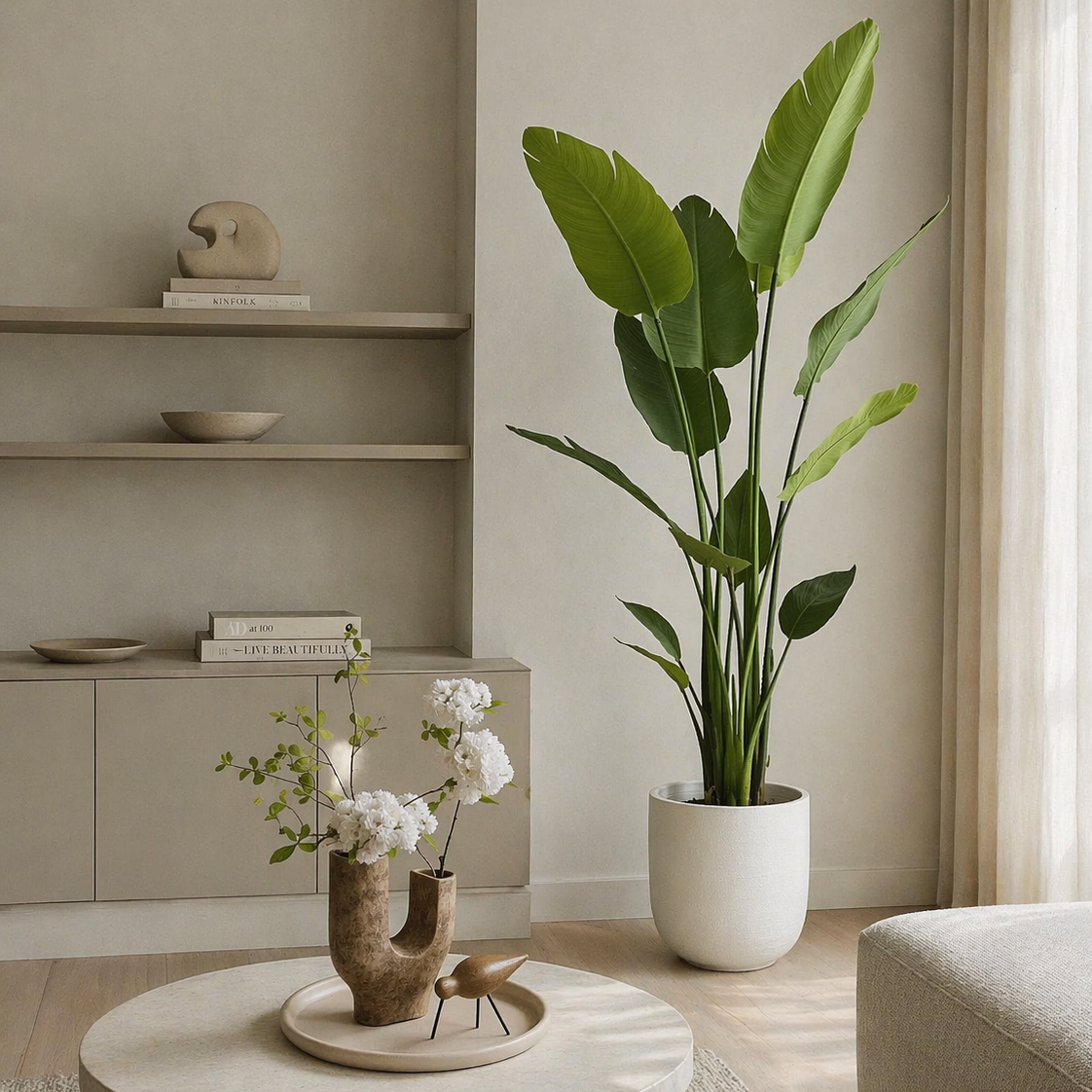
A plant that looks real also has realistic proportions. An artificial strelitzia with broad, long leaves on sturdy stems instantly feels real because it has the same scale as the plant you know. Leaves that are too small on a large plant, or a trunk that's too thin under a full crown, spoil the picture. So look not just at total height, but at leaf size and stem thickness too. At Forme Flora you'll find them in different heights: from small artificial plants and medium artificial plants to hanging artificial plants.
7. The pot completes it
Even the most beautiful artificial plant loses its charm in a cheap plastic pot with visible foam on top. A realistic finish matters: a stylish pot and a top layer that looks like soil, moss or gravel. In our Plant & Pot collection every plant comes in a matching pot, so the whole look is right.
The touch test and the distance test
Not sure about a plant? Do two simple tests. First look at it from a few metres away, as you usually would at home. Does anything about the colour or shape stand out? Then look up close and feel the leaf. A quality plant passes both: from a distance it's indistinguishable from real, and up close you see details you didn't expect.
Why quality pays off
A high-quality artificial plant costs more than one from a DIY store. But it also lasts much longer. Good materials fade less quickly, keep their shape and stay beautiful for years. And a realistic plant genuinely upgrades your interior, while a fake-looking one cheapens it. Read more about lifespan in our article on the sustainability of artificial flowers and plants.
Buying online: what to watch for
Online you can't hold the plant. So look closely at lifestyle photos in a real interior, read the dimensions and check detail shots of the leaf and trunk. Also read our tips on buying artificial plants online. At Forme Flora you also get a 14-day cooling-off period to judge the plant calmly at home.
Conclusion
You recognise an artificial plant that looks real by its matt, veined leaves, natural colour gradients, a trunk that looks like wood, a loose and natural shape, realistic proportions and a beautiful pot. Keep those seven points in mind and you'll choose a plant you'll proudly display for years. Browse our artificial plants with pot and discover how real artificial can be.